

Every second matters in the critical care department, the ICU. The quality of the medical equipment has a direct impact on the patient’s safety, caregiver efficiency and treatment outcomes. Among all the equipment, the ICU hospital bed plays a key role in supporting ill patients who require 24/7 monitoring, advanced medical interventions and long-term care.
It is thus very important to choose the right ICU bed not only for patient comfort but also for improving clinical workflows, reducing caregiver strain, preventing complications and ensuring quick emergency response. Whether you are setting up a new hospital or upgrading your ICU infrastructure, investing in the right hospital ICU bed can improve patient care.
What is an ICU Bed?
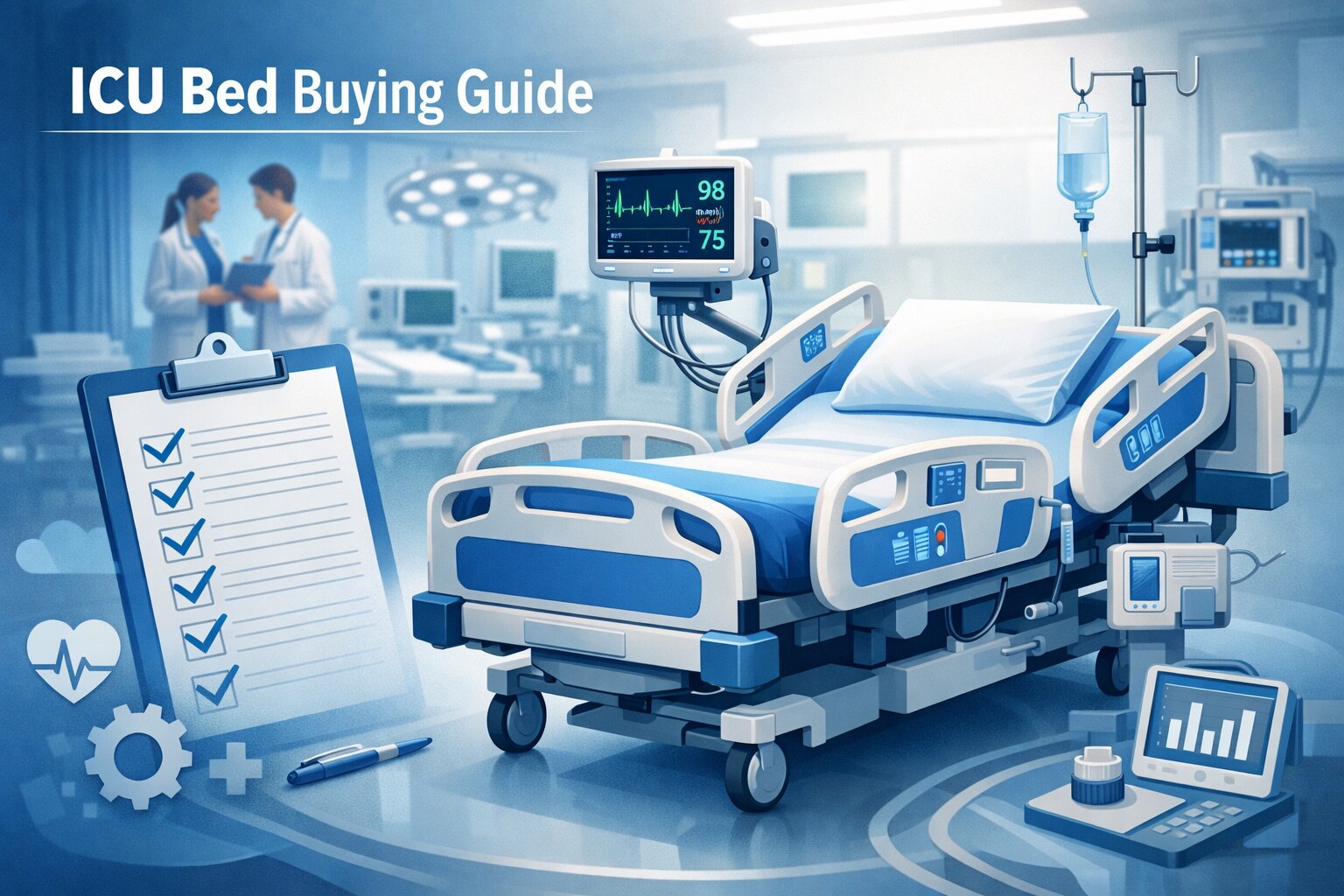
ICU bed is a specialized hospital bed designed for critically ill patients requiring intensive medical care. ICU bed features the cutting-edge electric controls, adjustable height and positioning, side rails, CPR release mechanisms, patient weighing systems, mobility device and compatibility with life support devices like ventilators, infusion pumps, and patient monitors.
The Intensive Care beds help medical professionals provide safer, faster and more efficient treatment while improving the comfort of patients during prolonged hospitalization.
ICU Bed Buying Guide
- Fully Electric Operation: The modern ICU bed must include electric adjustments. This helps in easy adjustments of height, backrest, knee rest and trendelenburg/ reverse trendelenburg positioning. The electric controls allow caregivers to reposition patients quickly with less physical effort while ensuring utmost comfort. The benefits of fully electric ICU beds are faster patient positioning, reduced caregiver fatigue, and improved emergency response and better patient comfort.
- Advanced Patient Positioning: One of the significant things to consider before buying ICU beds is to ensure the bed offers multiple positioning, including the Fowler position, cardiac chair position, trendelenburg/ reverse trendelenburg and auto contour positioning. These positions help respiratory care, cardiac recovery and patient rehabilitation.
- High Weight Capacity: Hospitals treat patients of varying body types. One of the key features of modern ICU beds is that they support bariatric patients as well. Choosing ICU beds that support patients of all types ensures better stability, increased patient safety, reduced maintenance issues and long-term durability.
- Reliable Side Rails: The best ICU beds for hospitals have reliable side rails. This prevents falls, a common hospital incident. The premium quality ICU beds have ergonomic collapsible side rails with a secure locking system. Quality side rails help prevent accidental falls, improve patient confidence, support safe repositioning and provide additional caregiver help.
- CPR quick-release mechanism: Every second matters during cardiac emergencies. An ICU bed should feature a manual or automatic CPR quick-release mechanism that instantly flattens the backrest, allowing the doctors to begin the resuscitation work without any delay.
- Easy Mobility: One of the key things to consider in the ICU bed buying checklist is that the bed is easy to move. The critically ill patients are transported for imaging, surgery or specialized treatment. Invest in the beds with heavy-duty medical castors, a central braking system, smooth mobility and directional locking wheels. These features improve the transportation of patients from one place to another while maintaining their stability.
- Prevent Pressure Ulcers: Patients in the ICU remain bedridden for extended periods, increasing the risk of bed sores or pressure ulcers. Check if the bed supports air mattresses, pressure redistribution mattresses, and alternating pressure systems. These beds, along with adjustable positioning, reduce skin injuries and improve recovery.
- Easy to Clean: Hospital-acquired infections remain a major concern in critical care settings. Look for a professional ICU bed manufacturer, selling beds with anti-bacterial powder-coated surfaces, corrosion-resistant materials and seamless construction. Make sure the bed has easy-to-clean parts.
- Integrated Patient Monitoring Compatibility: Modern ICUs rely on medical technology. Choose the ICU beds that are compatible with ventilators, infusion pumps, cardiac monitors, oxygen cylinders, IV poles and patient lifting accessories. The integrated accessory mounting points improve workflow while reducing equipment clutter around the patient.
- Durability and Certifications: Intensive Care Unit beds purchased from a dedicated ICU bed supplier are long-lasting. They have ISO certifications and are CE and FDA compliant. Their spare parts are also easily available. The manufacturer provides good warranty coverage and technical support. The reliable after-sales support reduces equipment downtime and ensures uninterrupted patient care.
Case Study
A 300-bed multi-speciality hospital experienced frequent challenges in its intensive care department. Nurses reported delays in patient repositioning due to manually operated beds, while prolonged immobility contributed to a higher incidence of pressure injuries among long-term ICU patients.
Healthcare staff faced challenges transporting seriously ill patients for imaging procedures, increasing fatigue. To address these issues, the hospital worked with a professional medical equipment supplier and exporter and upgraded its ICU with advanced electric beds.
Within a few months, the hospital observed measurable improvements. The caregivers were able to reposition patients more quickly and safely, reducing physical strain on staff. The incidence of bed sores was reduced due to better patient positioning. Emergency response time improved, and patient transfers became smoother, increasing workflow efficiency across departments.
This case study shows how choosing the right ICU bed can positively impact both clinical outcomes and operational efficiency.
ICU bed is more than a piece of hospital furniture. It is a key part of critical care. From improving patient safety and supporting life-saving procedures to increasing caregiver efficiency and reducing complications, the right ICU beds contribute to better healthcare delivery.
FAQs
- What are the four important functions of ICU beds?
Four important functions of an ICU bed are providing optimal positioning, ensuring the safety of patients, supporting life-saving medical procedures and improving caregiver efficiency during critical care. United Poly offers the best quality ICU beds that perform all these functions. - How to choose an ICU bed for hospitals?
Choose an ICU bed for hospitals by checking its safety features, electric adjustability, patient comfort, durability, equipment compatibility and compliance with healthcare quality guidelines. - Which ICU bed is best for hospitals?
The best ICU bed for hospitals is a fully electric ICU bed with state-of-the-art positioning, CPR functionality, safety side rails, mobility features and compliance with global medical standards. United Poly offers premium-quality ICU beds tailored to hospital ICU requirements.
About the Author
United Poly is a trusted Indian manufacturer, supplier and exporter of the best quality medical equipment. With more than 40 years of industry experience. Backed by ISO 9001: 2015, ISO 13485:2016, FDA and CE certifications, the brand is committed to manufacturing healthcare products that meet strict global quality and safety standards.
With innovation, reliability and quality, the brand offers a wide range of hospital equipment, including ICU beds, walkers, wheelchairs and more, designed to enhance patient care, improve safety and support efficient hospital operations.